 Tali Weinstein
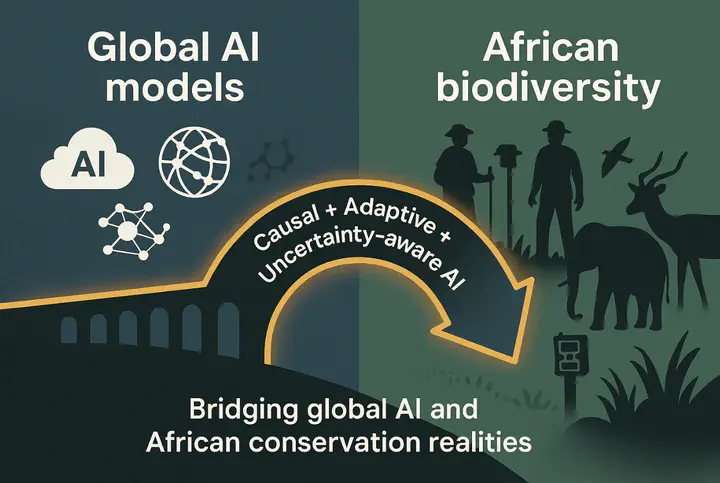
The project ‘Bias: Endangering Species and Model Performance’ investigates how long-tail imbalance and contextual bias in global wildlife classification models disadvantage endangered and data-deficient species. Using camera-trap data from Malawi’s Nkhotakota Reserve, Austin Kaburia and I evaluated SpeciesNet’s performance across species of differing IUCN conservation status. Results revealed a stark disparity in recall between common and vulnerable species (0.68 for impalas vs. 0.18 for leopards), exposing systematic underrepresentation of endangered taxa. To address this, the project fine-tuned SpeciesNet using taxonomic grouping, IUCN Red List metadata, and uncertainty quantification methods such as Generalized Additive Models (GAMs) and calibrated mixture models. These techniques improved endangered-species recall, introduced interpretable diagnostics for failure modes like nocturnality and foliage occlusion, and allowed the model to flag “unknown” cases for ranger review.
Beyond its technical contributions, the work aims to propose a new evaluation framework emphasizing endangered-species recall and calibration metrics aligned with conservation risk, filling a key gap in current literature. By bridging ecological insight with machine learning rigor, the project advances African-led AI for biodiversity monitoring and conservation safety. The work has been recognized with 3rd place at the 2025 African Computer Vision Summer School Hackathon, a Poster Award at the 2025 Deep Learning Indaba and a first place win at the Deep Learning Indaba Ideathon 2025, clearly underscoring the project’s scientific and societal impact.
A big thank you to Austin Kaburia for his research prowess and Kevin Kibaara for his digital media skills for our video submission.
Skills:
AI for Conservation, Bias Evaluation, Model Validation, Cross-Disciplinary Collaboration

Taliya Weinstein
Research Engineer and Data Scientist
Pursuing inventive, interdisciplinary solutions for impactful change while advancing the engineering field.